Disce ludens I
Beginners · 31 lessons
Parts of speech, parts of the sentence, declensions and conjugations of the first two years of Latin, with forms and syntax taught together.
Latin course · since 1998
Disce ludens guides learners step by step through forms, syntax and vocabulary. Hints are free; the solution costs a point. Built from 30 years of classroom teaching by Thomas Wegener.
The app currently teaches in German. An English edition is planned.
The app launches soon. Leave your email address and we will let you know.
Disce ludens I · Lesson 8 · Parts of the sentence
Mater et pater pueros iam ad ianuam exspectant.
Which part of the sentence is marked?
Disce ludens is a Latin course for the first years of Latin: 69 lessons on forms and syntax, a translation trainer with sentences from Caesar and a vocabulary trainer with 1,565 words. It was written by the Latin teacher Thomas Wegener and now runs as a web app with no ads and no trackers; the demo is free.
It fails on endings that will not stick, on sentences where you cannot find the verb, and on homework nobody at home can help with.
Disce ludens drills exactly these points: every form, every part of the sentence, step by step, with hints that show the way without giving the answer away.
Switch at any time, even in the middle of a lesson. Progress and errors are kept.
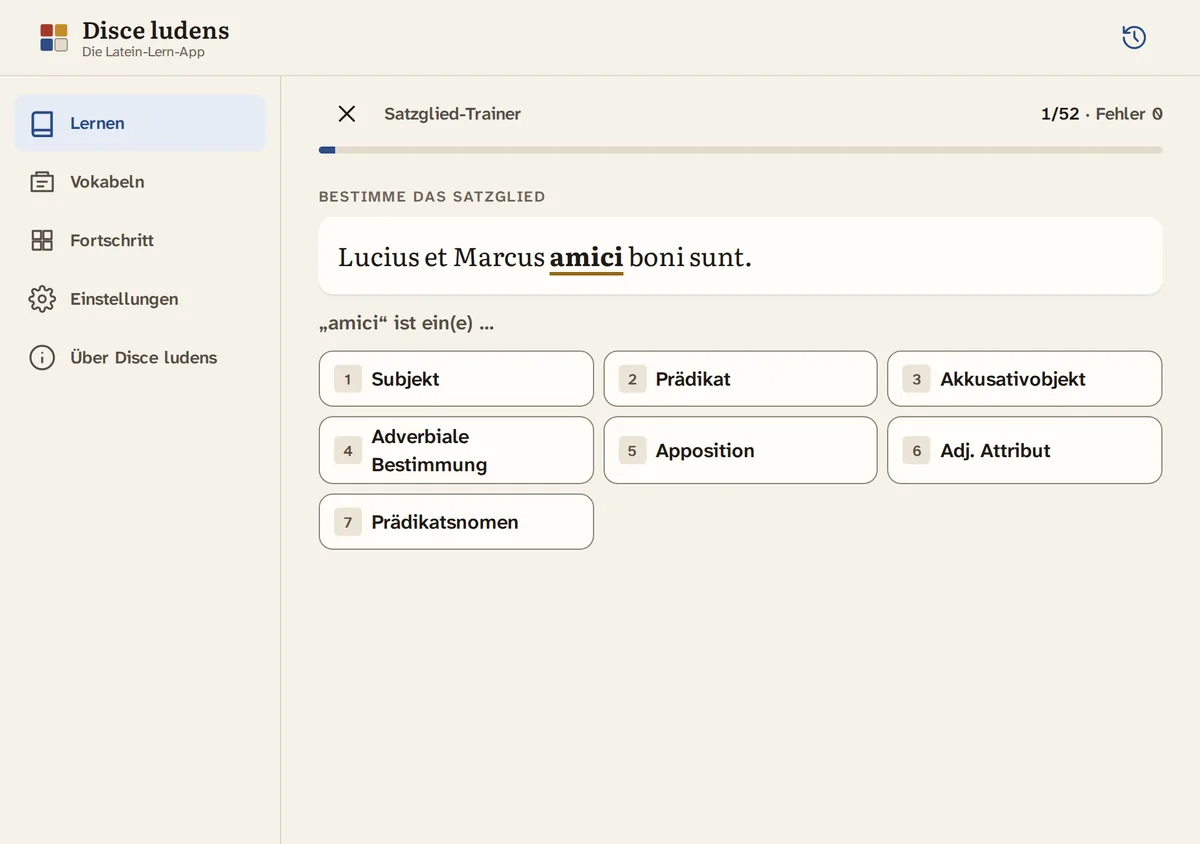
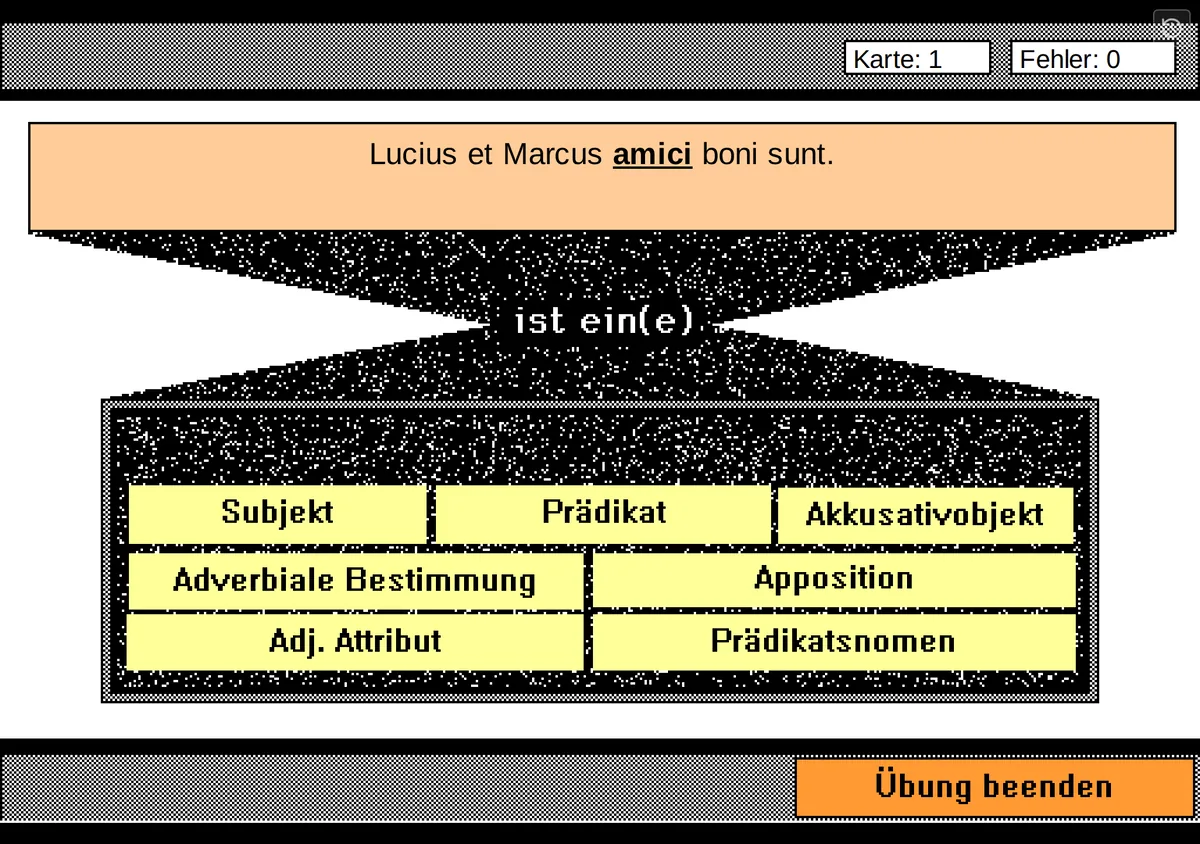
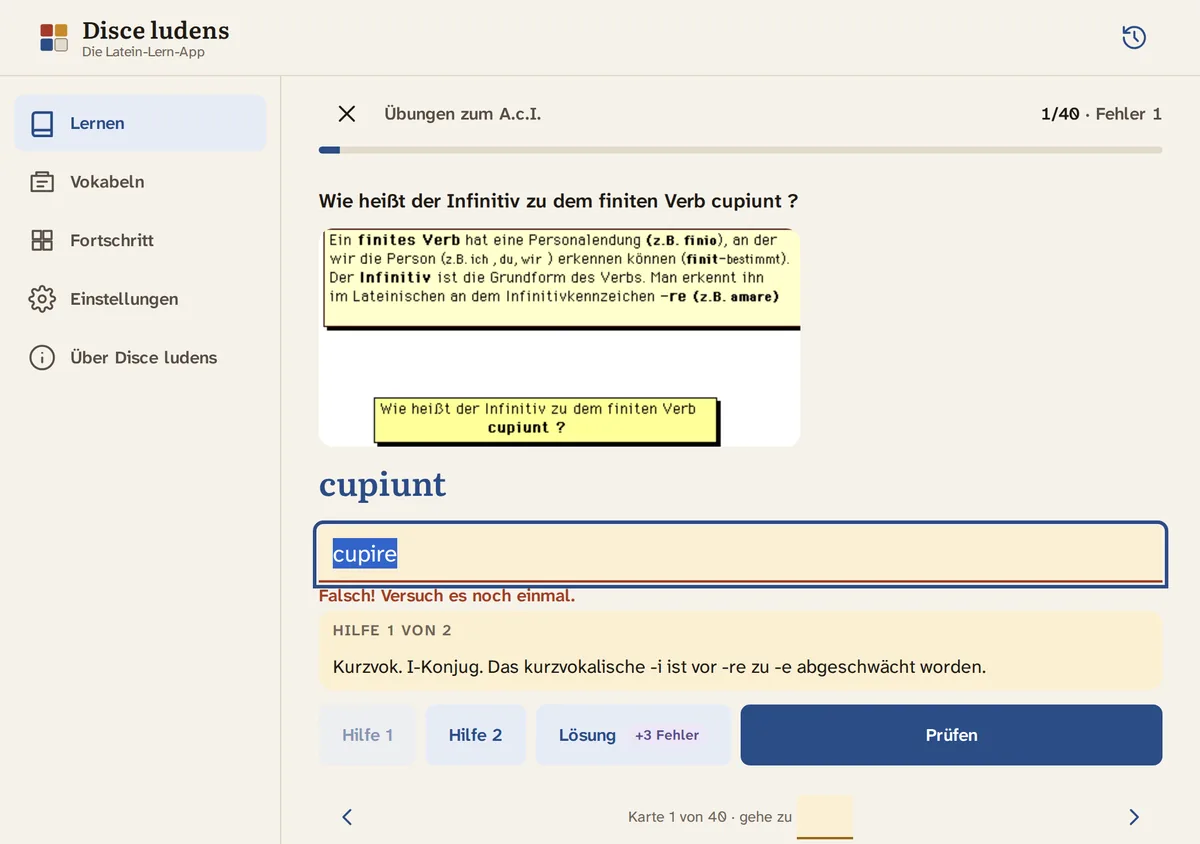
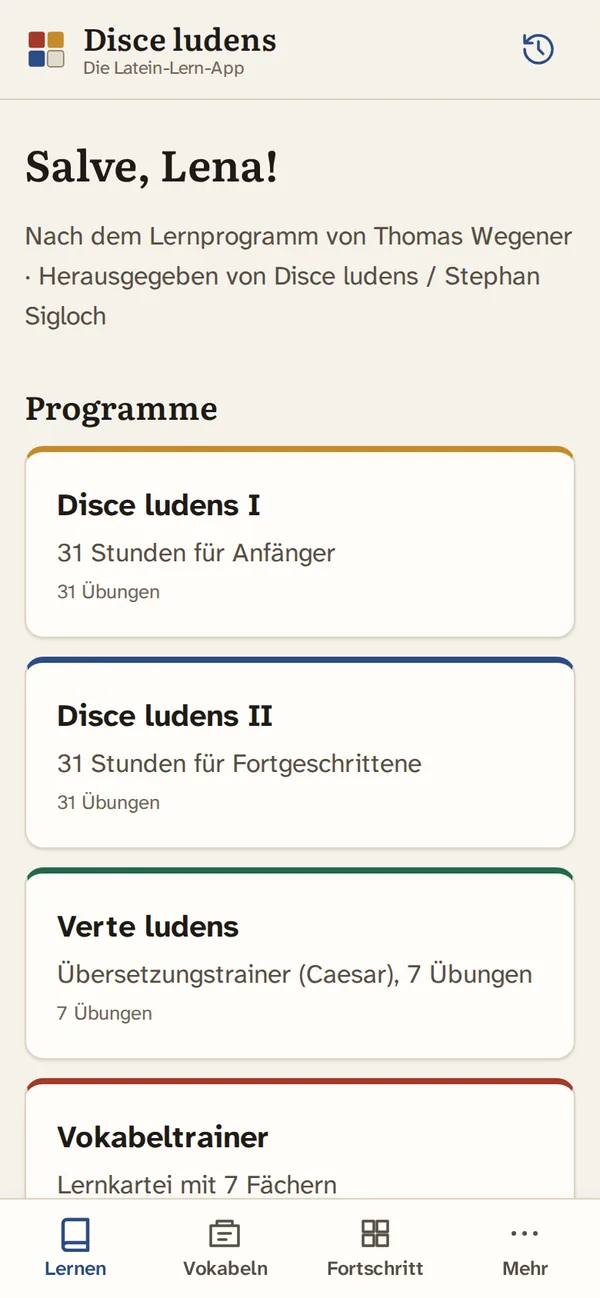


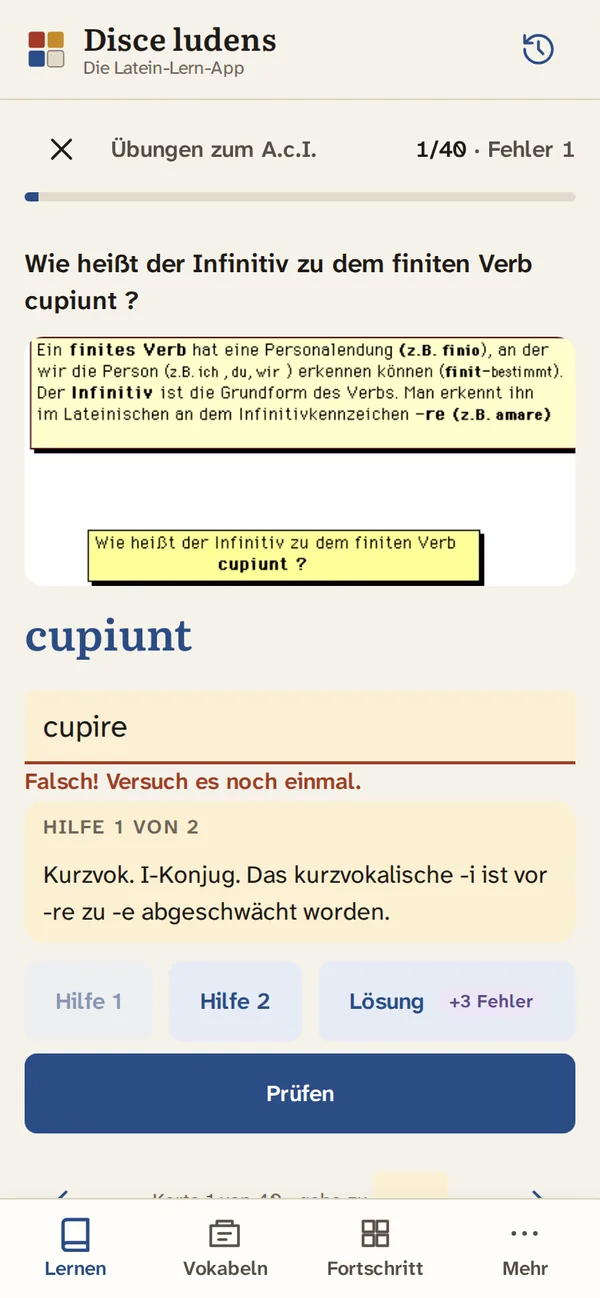
Nostalgia mode is made for computers and tablets; on a phone it runs in landscape.
Beginners · 31 lessons
Parts of speech, parts of the sentence, declensions and conjugations of the first two years of Latin, with forms and syntax taught together.
Intermediate · 31 lessons
The sequel: subjunctive, participles, infinitives, subordinate clauses and the major constructions.
Translation trainer · 7 exercises
Original sentences by Caesar, translated step by step with vocabulary, background information and guiding questions.
1,565 words · 7 boxes
A Leitner card box: words you know move back, words you miss come round again soon. Separate boxes for each direction.
Almost every exercise has graded hints that show the way without giving the answer away. Revealing the solution costs error points.
Answers are checked tolerantly: capitals at the start, spaces and the final full stop do not count. For forms, every letter matters.
The lessons follow the grammar of the first years of Latin, not one particular book. The recommended order comes from the original; every lesson can be opened on its own.
Nostalgia mode shows the exercises as they looked in 1998. Modern mode is clean, readable and works with keyboard and screen reader. Switch at any time.
Thomas Wegener taught Latin at the Dillmann-Gymnasium in Stuttgart, Germany. Between 1997 and 2005 he turned 30 years of teaching into three learning programs for Windows. He tested the lessons in his own classes; the drawings were made by his students.
Disce ludens means “learn by playing”. Stephan Sigloch continues the programs in succession to Thomas Wegener and has rebuilt them as an app, with the same exercises, hint texts and error logic as the original.
Free to try: Disce ludens I lessons 1–3 and the vocabulary trainer with 20 words. Disce ludens I and II include the vocabulary trainer.
| Package | per year | one-time |
|---|---|---|
| Disce ludens I | €19 | €39 |
| Disce ludens II | €19 | €39 |
| Verte ludens | €19 | €39 |
| Vocabulary trainer only | €9 | €19 |
| Everything | €39 | €89 |
Schools: everything for €3 per student per year. Ask for a school licence.
Disce ludens is a Latin course for the first years of Latin with 69 lessons, 4,260 exercises and a vocabulary trainer. It was written by the Latin teacher Thomas Wegener and now runs as a web app.
Yes, Disce ludens works with any textbook and follows the grammar of the first years of Latin. Every lesson can be opened on its own if your book uses a different order.
The demo is free; each program costs €19 per year or €39 one-time, everything €39 per year or €89 one-time. Schools pay €3 per student per year.
Not yet; at launch the app explains Latin in German. An English edition is planned.
No, a guest access without an email address is enough to learn. Full access is unlocked with a licence code.
No, the app has no ads and no third-party analytics or advertising services. Names stay in the browser; the server only knows an anonymous ID.
Disce ludens.
Learn by playing.
The app launches soon. Leave your email address and we will let you know.